

Inspire people both in person and online!


Event activation
Are you planning an event, a roadshow or a sponsorship campaign and want to engage visitors in a unique way? We develop an interactive event experience, which attracts attention, engages visitors and brings your brand to life.

Crowd puller at the trade fair
Are you looking for an easy way to strike up a conversation and keep visitors at your exhibition stand for longer? With a marketing game or an interactive application, we can create a digital crowd-puller that attracts visitors, engages them and gets your team talking.

Shopping experience at the point of sale
Do you want to captivate customers in retail outlets, shopping centres or at the point of sale, and trigger targeted impulse purchases? We’ll develop your interactive brand experience, which catches the eye, showcases your products and leaves a positive impression of your brand.
Online activation
Are you looking for a digital experience for your campaign, website or social media initiative? We’ll develop a web-based marketing game or brand experience that engages people online, generates leads and brings your brand to life.
The right activation for every touchpoint
People remember brands when they don’t just watch, but get actively involved themselves. This is exactly where marketing games and interactive brand experiences come in: they turn an advertising message into an experience in which your target audience plays, makes decisions, discovers things or interacts directly with your brand.
Screenable develops bespoke digital experiences for events, trade fairs, the point of sale and online campaigns. What matters is not the format, but the objective: to attract attention, draw in visitors, bring products to life, generate leads or encourage purchases.
From games on LED screens to interactive competitions in shopping centres and browser-based campaigns: depending on the concept, smartphones, touchscreens, large displays, buzzers or other control elements are used.
Event activation: capturing attention at just the right moment
Events offer something that traditional online advertising can hardly achieve: a shared moment. People are there in person, open to new experiences and ready to give things a go. A digital event activation capitalises on this moment and turns spectators into active participants.
This could be a quick challenge on a screen, a quiz with lots of participants, a digital wheel of fortune or a fun sponsorship activity. Large displays and LED walls are particularly well suited to this, as they involve not only the person taking part but also the audience.
Event activations are ideal for promotional campaigns, festivals, sporting events, roadshows or sponsorship initiatives. The experience can then be linked to a voucher, a prize draw or another form of digital interaction.
Exhibition stand: From crowd-puller to conversation starter
At a trade fair, many companies compete for attention in a confined space. An interactive experience can therefore help to attract visitors in a targeted way and provide a natural starting point for a conversation.
A marketing game at the exhibition stand gives people a simple reason to stop and take part. Rather than starting with a direct sales pitch, it creates a positive interaction right from the start. This makes it easier for the stand staff to strike up a conversation afterwards.
Depending on the objective, the campaign can be geared more towards entertainment, product knowledge, recruitment or lead generation. A quiz imparts knowledge, a challenge creates a sense of competition, and a prize draw can be combined with a request for contact details.
The main difference from traditional event promotion lies in the objective: at the exhibition stand, the experience should not only attract attention, but also draw people to the stand, keep them there and engage them in conversation.
Point of Sale: Shopping becomes interaction
In retail, in shopping centres or during a promotional event directly at the point of sale, gamification can turn attention into a concrete impulse to buy.
An interactive shopping experience at the point of sale can surprise customers, explain a product or provide a direct incentive to buy. Examples include digital slot machines, wheels of fortune, product challenges or prize draws.
The link between the game and the subsequent call to action is particularly interesting. After taking part, for example, a voucher, a promotional code or product information may appear directly on the smartphone. In this way, the engagement does not end with the game, but leads straight to the next step.
POS activations can be designed for individual promotional days or over longer periods, and are suitable for both promotional campaigns and permanent digital shopping experiences.
Online activation: More than just another click
Interactive brand experiences do not have to be tied to a physical location. With an online activation, people can take part directly via their smartphone or desktop – via a website, social media, a newsletter, digital advertising or a QR code.
Instead of simply showing users a message, they are actively involved. They answer questions, make decisions, test their knowledge or take part in a short challenge.
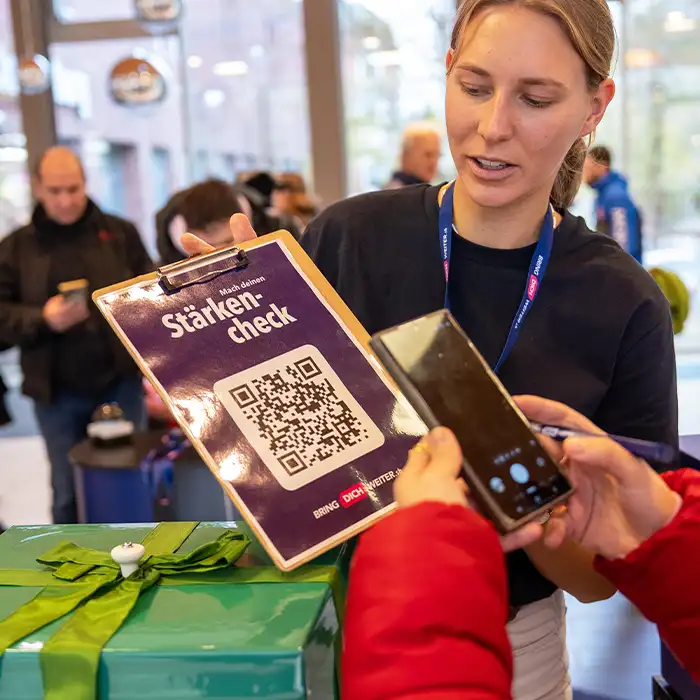
One example of this is BringDichWeiter.sh. Here, the topic of further learning is presented in an accessible and interactive way via a digital strengths assessment. Users answer a few questions and are then given a personalised assessment and suitable next steps.
Online activations are particularly suitable when a campaign is designed to reach a large number of people, regardless of location or time. At the same time, interactions can be measured and linked to lead generation or other conversion goals.
Thinking together, both in person and online
Interactive campaigns are particularly effective when several areas of application are linked together. For example, an in-person activation can be continued on a smartphone via a QR code. A trade fair game can remain accessible online after the event, and a digital campaign can guide people specifically towards a physical activity.
At Science Comes to Town in Kiel, for example, physical stations across the city were linked to digital content. Visitors explore scientific questions on site and can access further content and interactive activities via QR codes.
This is precisely where the strength of interactive brand experiences lies: they can be linked across various touchpoints to form a unified campaign.
Whether it’s an event, a trade fair, a point of sale or an online campaign: we develop engagement strategies tailored to your target audience, your brand and your marketing objectives. The result might be a marketing game – but it doesn’t have to be. What matters is that people aren’t just reached, but that they take an active part and experience your brand for themselves.
Frequently Asked Questions
At exhibition stands, an interactive experience often needs to engage visitors within a matter of seconds and provide a quick way to start a conversation. At events, there is often more scope for a longer, shared brand experience. We therefore tailor the game mechanics, duration and call to action to the specific context.
Yes, so-called hybrid or phygital formats combine an in-person gamification experience with parallel online participation, ensuring that people who do not visit the stand are also involved. This extends the reach beyond the event venue and enables a shared leaderboard or a joint competition for both target groups.
If you want to attract visitors to your exhibition stand in a targeted way and spark conversations, an exhibition campaign is the ideal solution. Events are ideal for shared brand experiences, the point of sale for product presentation and encouraging purchases, and online campaigns for location-independent reach and lead generation. Screenable develops tailored concepts for each of these four areas.
An interactive game element gives visitors a specific reason to stop rather than walk past, and creates an incentive to stay longer through high scores or the chance to win prizes. This can increase the length of time visitors spend at the stand and allows more time for conversations with the stand staff.
Yes, digital games can be used regardless of the size of the event, for example as a mobile experience accessed directly via participants’ own smartphones. For smaller-scale events, the focus is usually less on reach and more on targeted branding and knowledge transfer.